


The benefits
of coffee for hair
From your morning routine to a new look for your hair at professional salons!
On this page, we delve into:
Coffee used to mean just one thing: the drink that gives you a boost in the morning. Today, it has moved beyond the confines of the café and into the world of hair and beauty. Clients are asking about coffee rinses and caffeine-based shampoos, DIY tutorials continue to circulate online, and the ingredient itself is even appearing in professional formulations. Before recommending it, it’s worth finding out what the research actually shows and in which cases caffeine truly deserves a place in the salon routine.
What the research says about the benefits of coffee for hair

The interest in coffee in relation to hair is genuine (and scientifically proven). A study found that caffeine helped to counteract the effects of dihydrotestosterone (DHT), the hormone responsible for androgenetic hair loss, in both male and female hair follicles. The same study observed that caffeine prolonged the anagen phase, the active growth stage of the hair cycle, and stimulated hair shaft elongation.
Two mechanisms explain much of what customers notice:
- Microcirculation: caffeine is a stimulant and, when applied topically, promotes blood flow to the scalp. Improved circulation means that the follicle receives nutrients more efficiently, which, over time, promotes a healthier growth environment.
- Antioxidant protection: coffee contains flavonoids and chlorogenic acid, antioxidants that help protect the hair shaft from oxidative stress caused by daily exposure to environmental factors, the use of heat-styling tools and chemical treatments.
None of this makes coffee a cure for hair loss or a substitute for clinical treatment. The evidence is real but limited, and clearly managing clients’ expectations is just as important as recommending the ingredient itself.
Coffee hair treatment benefits, explained for the chair

Here's how these effects typically show up in a real service or consultation:
- Thinning or fragile hair: clients dealing with early thinning or scalp fatigue tend to respond well to caffeine-based scalp care used consistently over several weeks.
- Shine and texture: the antioxidant content can smooth the hair shaft, which reduces frizz and improves how light reflects off the strand. Clients with dull or dry hair are often the best candidates to notice a difference.
- Tone depth: coffee's natural pigment can add depth to brunette tones over repeated use. It's worth being clear that this is a cosmetic, temporary effect, not a substitute for a professional color service.
DIY coffee rinse VS professional caffeine hair products
This is the part most consumer content skips entirely, and it's the part that matters most to a colorist. A client rinsing homemade coffee through freshly colored or lightened hair introduces an uncontrolled variable: inconsistent pigment deposit, unpredictable staining on porous or over-processed sections, and a pH swing right before or after a chemical service.
This is a genuinely useful thing to explain at the chair. A client who understands why their homemade rinse might be undercutting their last color service is a client who trusts your recommendation more.
Bringing caffeine into your professional salon
Salons are increasingly building caffeine into their offerings rather than leaving it to guesswork at home. It tends to show up in two main ways:
- As a scalp-care ingredient in shampoos and treatments designed for thinning or fragile hair, used as part of an ongoing retail or backbar routine.
- As an active ingredient inside color formulas themselves, where it can support scalp comfort and reduce service time without adding a separate step.
Nouvelle's caffeine-powered lines
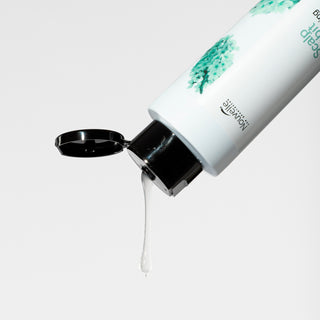
Scalp Habit - Energizing shampoo
- Formulated with caffeine among its active ingredients.
- Designed for fragile scalps and hair with a tendency to fall.
- Cleanses gently while supporting a feeling of strength and vitality, making it a natural recommendation for clients asking about thinning or scalp fatigue between services.
Scalp Habit - Energizing shampoo
- Formulated with caffeine among its active ingredients.
- Designed for fragile scalps and hair with a tendency to fall.
- Cleanses gently while supporting a feeling of strength and vitality, making it a natural recommendation for clients asking about thinning or scalp fatigue between services.
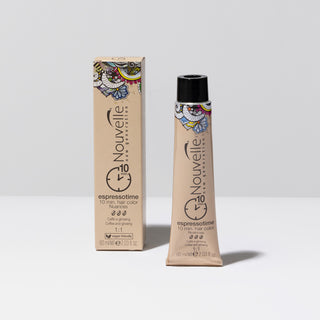
Espresso time
- Active ingredient: Green Fermented Coffee, present across the 10 Min Hair Color and Developer.
- Beyond the caffeine content itself, the formula is built to cut color service time significantly, addressing a real scheduling pressure many salons face today.
Espresso time
- Active ingredient: Green Fermented Coffee, present across the 10 Min Hair Color and Developer.
- Beyond the caffeine content itself, the formula is built to cut color service time significantly, addressing a real scheduling pressure many salons face today.
Explore Nouvelle's lines to see how caffeine performs when it's built for professional use
or contact us for more information!
FAQ
- Does coffee actually regrow hair, or is it just a cosmetic effect?
Research shows caffeine can support the hair growth cycle and counteract some effects of DHT at the follicle level, but it isn't a clinical treatment for hair loss. It works best as a supportive, ongoing part of scalp care, not a one-time fix. - Is it safe to recommend a coffee rinse to clients with colored or lightened hair?
Not without caveats. A homemade rinse can stain porous or lightened hair and shift scalp pH at an inconvenient moment. A professionally formulated caffeine product is the safer recommendation around a color service. - How is caffeine different from other scalp-stimulating ingredients?
Caffeine's specific value is its documented action on DHT and microcirculation, supported by peer-reviewed research, which sets it apart from many trend-driven scalp ingredients with thinner evidence behind them.